
Book Resume
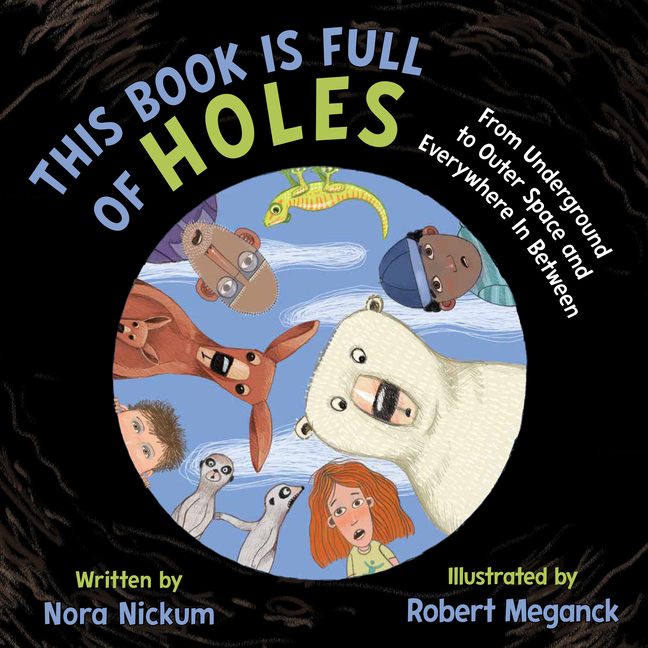
for This Book Is Full of Holes: From Underground to Outer Space and Everywhere in Between by Nora Nickum and Robert Meganck
Professional book information and credentials for This Book Is Full of Holes.
3 Professional Reviews (1 Starred)
1 Book Award
Selected for 1 State/Province List
- School Library Journal:
- K - Grade 3
- Booklist:
- Grades 1 - 4
- Kirkus:
- Ages 8 - 11
- TeachingBooks:*
- Grades 1-6
- Word Count:
- 3,066
- ATOS Reading Level:
- 5.9
- Genre:
- Nonfiction
- Year Published:
- 2024
1 Subject Heading
The following 1 subject heading were determined by the U.S. Library of Congress and the Book Industry Study Group (BISAC) to reveal themes from the content of this book (This Book Is Full of Holes).
3 Full Professional Reviews (1 Starred)
The following unabridged reviews are made available under license from their respective rights holders and publishers. Reviews may be used for educational purposes consistent with the fair use doctrine in your jurisdiction, and may not be reproduced or repurposed without permission from the rights holders.
Note: This section may include reviews for related titles (e.g., same author, series, or related edition).
From School Library Journal
March 1, 2024
K-Gr 3-This nonfiction picture book delves into many types of holes, including a piggybank, sewing needle, sinkhole, hole in the ozone, blowhole, and pores. Whether they are deep, shallow, big, or small, they are everywhere, and this book offers readers plenty of information on the topic. Every spread covers related holes. "A hole can form slowly/ or quickly" is about potholes and sinkholes while "There can be a lot of holes/ or just one" is about a sprinkler and a hose. The key word in each phrase uses a different font for emphasis. The colorful, cartoon-style digital illustrations use clean lines and never lose their grip on reality or venture into anthropomorphism. They are integral to the text as they clearly and often humorously show the hole or holes with helpful visual context. Each one appears in its own vignette. People are depicted with a variety of skin tones. For those who want to know more, a block of black text in a white box offers information about the hole pictured. These boxes are full of interesting and fun facts, but can be skipped for readers caught up in the main flow of information. The final pages contain a section with examples and explanations of relevant words and phrases (e.g., hole-in-one, loophole, etc.) and a list of further reading. VERDICT An easy-to-read concept book that is great for various ages and interest levels, and a welcome addition for all libraries.-Catherine Callegari
Copyright 2024 School Library Journal, LLC Used with permission.
From Booklist
February 15, 2024
Grades 1-4 Nickum introduces the abstract concept of holes: ""A hollow place. An empty space. A part of something where there's nothing at all."" Most examples express contradictions: "A hole can form slowly . . . / . . . or quickly," for example, is depicted with illustrations of a pothole and a sinkhole, with detailed sidebar explanations of each. Readers will be familiar with some (sock holes, sprinkler holes) but not all examples of empty spaces (wormholes and holes in airplane windows designed to equalize air pressure). The detailed descriptions are scientifically accurate yet within readers' grasp. Meganck's digital artwork employs a cartoon style that adds humor in appropriate spots. He also adds examples that go beyond the text: indentation, for instance, is depicted with a waffle and honeycomb. The muted palette often pairs greens with browns and purples. With a concluding section explaining English-language expressions related to holes (loopholes, pigeonholes, rabbit holes, etc.), this makes a thought-provoking STEM-themed read-aloud.
COPYRIGHT(2024) Booklist, ALL RIGHTS RESERVED.
From Kirkus
Starred review from January 15, 2024
Nothing can actually turn out to be a great deal of something. Consider the humble hole. Just how many holes are there? According to this ingenious and creative treatise that purports to tell the "hole" truth about the "empty spaces" all around, they're ubiquitous: They can be found on land, underwater, in space, and even in airplane windows; they can be created by animals as well as by humans. They serve a dizzying array of purposes (holes in the ice help ringed seals breathe while hunting fish), come in a wide variety of sizes, shapes, and depths, and may develop rapidly (like sinkholes) or over time (like potholes). Readers might be surprised to discover that not all holes are empty. Brief paragraphs thoughtfully and conversationally explain various types of hole, from the indentations in waffles to sound holes in guitars and violins. Each spread starts with a statement that introduces a different type of hole and its opposite: "A hole can be tiny...or enormous." "A hole can be made to get in...or out." "A hole can be used to make art...or music." This wide-ranging and insightful work will have readers looking at the world in a new light. Colorful, lively digital illustrations clarify the informative material with quirky humor. Humans are racially diverse. Hole-y cow! This winning book adds up to a "whole" lot of fascinating, thought-provoking fun. (idiomatic sayings about holes, information on black holes, bibliography) (Informational picture book. 8-11)
COPYRIGHT(2024) Kirkus Reviews, ALL RIGHTS RESERVED.
1 Book Awards & Distinctions
This Book Is Full of Holes was recognized by committees of professional librarians and educators for the following book awards and distinctions.
 Junior Library Guild Selections, 2012-2025, Nonfiction Selection, 2024
1 Selection for State & Provincial Recommended Reading Lists
This Book Is Full of Holes was selected by educational and library professionals to be included on the following state/provincial reading lists.
Australia Lists (1)
Queensland
- Queensland Premier’s Reading Challenge, 2024, Years 4-5
Preview Digital Book
Explore This Book Is Full of Holes on Marketplace. Access requires OverDrive Marketplace login.
This Book Resume for This Book Is Full of Holes is compiled from TeachingBooks, a library of professional resources about children's and young adult books. This page may be shared for educational purposes and must include copyright information. Reviews are made available under license from their respective rights holders and publishers.
*Grade levels are determined by certified librarians utilizing editorial reviews and additional materials. Relevant age ranges vary depending on the learner, the setting, and the intended purpose of a book.
Retrieved from TeachingBooks on December 24, 2025. © 2001-2025 TeachingBooks.net, LLC. All rights reserved by rights holders.
