

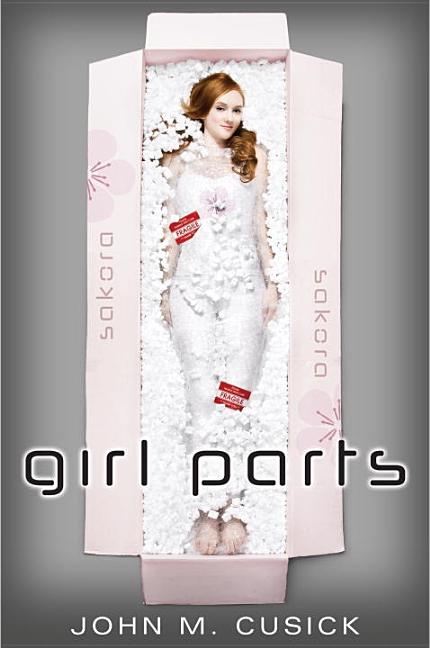
Book Resume
for Girl Parts by John Cusick
Professional book information and credentials for Girl Parts.
- School Library Journal:
- Grades 9 and up
- Publisher's Weekly:
- Ages 14 and up
- TeachingBooks:*
- Grades 7-12
- Word Count:
- 45,195
- Lexile Level:
- 590L
- ATOS Reading Level:
- 3.9
- Genre:
- Science Fiction / Fantasy
- Year Published:
- 2010
18 Subject Headings
The following 18 subject headings were determined by the U.S. Library of Congress and the Book Industry Study Group (BISAC) to reveal themes from the content of this book (Girl Parts).
- Popularity
- Massachusetts
- Science fiction
- Massachusetts--Fiction
- Robots
- Robots--Fiction
- Social classes
- Social classes--Fiction
- Family life
- Dissociative disorders--Fiction
- Family life--Massachusetts--Fiction
- Interpersonal relations--Fiction
- Families
- Dissociative disorders
- Popularity--Fiction
- Interpersonal relations
- Young Adult Fiction
- Young Adult Fiction | Social Themes | Dating & Sex
4 Full Professional Reviews
The following unabridged reviews are made available under license from their respective rights holders and publishers. Reviews may be used for educational purposes consistent with the fair use doctrine in your jurisdiction, and may not be reproduced or repurposed without permission from the rights holders.
Note: This section may include reviews for related titles (e.g., same author, series, or related edition).
From Horn Book
January 1, 2011
Privileged David Sun's parents, deciding their son is "dissociated," get him a Companion bot: curvy redhead Rose. Rose, rejected by David, turns to outsider Charlie, who opens up to Rose more comfortably than to real girls. Cusick's first novel is charming and witty, peppered with satirical jabs at the irony of being lonely and isolated in an increasingly connected world.
(Copyright 2011 by The Horn Book, Incorporated, Boston. All rights reserved.)

From School Library Journal
October 1, 2010
Gr 9 Up-With cold detachment, David views a classmate's video blog while she deliberately downs a toxic cocktail. He and his peers seem unfazed having witnessed her online suicide. The adults, shocked out of their reverie, notice that their children are "disassociated" from the real world. David's father, a techno tycoon, teams up with the school counselor to intervene. Enter Rose, an attractive robot girl designed to befriend David. She is beautiful, with silky hair and warm downy skin, and programmed to please. Electronic Rose will teach David how to love and feel again. No joke! Meanwhile, classmate Charlie is the antithesis of David. He and his botanist dad live off the grid on the outskirts of town. Charlie, a disheveled loner, rides a broken-down bike, and the school counselor labels him as depressed. He first suggests drugs and then a Companion, like David's. Rose generates much desire in her boy, but no substance. He remains a selfish, spoiled jerk addicted to surround monitors that flow constant communication among friends, all the while simulating suggestive images. When David discovers that Rose is more Barbie than girl-she is without "girl parts"-he casts her aside and breaks her "heart." Soon she takes up with Charlie and romance ensues. When the story digresses to Rose experiencing tender feelings and desiring "girl parts," the narrative stumbles. David remains artificially connected, Rose develops contrived humanistic drama, and Charlie falls for her. What began as a smart and sexy cautionary tale is ultimately disappointing.-Alison Follos, North Country School, Lake Placid, NY
Copyright 2010 School Library Journal, LLC Used with permission.

From Horn Book
September 1, 2010
"In a lifetime of kisses, some must be better than others, and the odds are low -- for any of us -- that the first will be the best. But few have had a better first kiss than Charlie Nuvola." At Saint Seb's prep school, Charlie is a lonely outsider, a shy boy from the wrong side of town, while David Sun, the privileged son of a CEO, is popular. When David witnesses the online suicide of a fellow student but does nothing to prevent it, his parents decide he has become dissociated, and his therapist recommends a Companion bot. Rose is a hot, curvy redhead who lives to please David, but she may only physically gratify him according to her Intimacy Clock. When David learns that Rose comes without "girl parts," that she is essentially a Barbie doll, his infatuation changes to displeasure. Rejected, Rose turns to Charlie, who finds he can open up to Rose much more comfortably than to real girls. It's a symbiotic relationship: as Rose helps Charlie transition to real girls, Charlie helps Rose seek reprogramming help to get David out of her system. It may be hard for readers to get this book out of their system: Cusick's first novel is charming and witty, peppered with satirical jabs at the irony of being lonely and isolated in an increasingly connected world. jonathan hunt
(Copyright 2010 by The Horn Book, Incorporated, Boston. All rights reserved.)
From Publisher's Weekly
July 26, 2010
In a very near future America where 750 viewers watch a teenager commit suicide online and do nothing, are humans more human than an android who looks and acts the part? With an almost anthropological eye, first-time novelist Cusick digs into the connections people make—physically, emotionally, and technologically. After David Sun’s parents learn that he witnessed the local girl’s death and didn’t intervene, they grow concerned that he has become “disassociated” from life, due to an overreliance on technology. The solution? More technology, of course, in the form of Rose, a Companion bot, which “dissuades dehumanizing behaviors and encourages healthy human interaction.” Rose is a redheaded bombshell, and while there are the requisite moments of misunderstood slang and other faux pas, she’s no more lost than the teenagers she meets, like scruffy loner Charlie. It’s Rose’s growth, with Charlie’s help after she’s brutally rejected by David, which forms the emotional core of this bittersweet and prescient novel, and which make the teenager-as-robot metaphor work so well. “He’s the whole universe,” Rose says of David, who alone she’s programmed to connect with. “What am I supposed to do?” Ages 14–up.

Preview Digital Book
Explore Girl Parts on Marketplace. Access requires OverDrive Marketplace login.
This Book Resume for Girl Parts is compiled from TeachingBooks, a library of professional resources about children's and young adult books. This page may be shared for educational purposes and must include copyright information. Reviews are made available under license from their respective rights holders and publishers.
*Grade levels are determined by certified librarians utilizing editorial reviews and additional materials. Relevant age ranges vary depending on the learner, the setting, and the intended purpose of a book.
Retrieved from TeachingBooks on December 24, 2025. © 2001-2025 TeachingBooks.net, LLC. All rights reserved by rights holders.
