

Book Resume
for Don Quixote by Miguel de Cervantes
Professional book information and credentials for Don Quixote.
5 Professional Reviews (2 Starred)
Selected for 1 State/Province List
- School Library Journal:
- Grades 5 - 7
- Publisher's Weekly:
- Ages 7 and up
- TeachingBooks:*
- Grades 9-12
- Lexile Level:
- 1410L
- Genre:
- Historical Fiction
- Year Published:
- 1615
9 Subject Headings
The following 9 subject headings were determined by the U.S. Library of Congress and the Book Industry Study Group (BISAC) to reveal themes from the content of this book (Don Quixote).
5 Full Professional Reviews (2 Starred)
The following unabridged reviews are made available under license from their respective rights holders and publishers. Reviews may be used for educational purposes consistent with the fair use doctrine in your jurisdiction, and may not be reproduced or repurposed without permission from the rights holders.
Note: This section may include reviews for related titles (e.g., same author, series, or related edition).
From Library Journal
Starred review from October 15, 2011
Spending 36 hours in the company of a 400-year-old novel sounds intimidating, but it needn't be--not when the book is as constantly amusing, inventive, and moving as Don Quixote. Cervantes's classic mock-heroic tale chronicles the adventures of a self-styled knight-errant whose efforts to restore medieval chivalry are a series of comic disasters. Considered the first modern novel, Don Quixote is one of the most entertaining stories ever told. Although John Ormsby's English translation is now 125 years old, it seems remarkably fresh. The novel's linear narrative is ideal for listening and combined with Roy McMillan's pitch-perfect narration makes those 36 hours nonstop pleasure for literature fans and general readers. Highly recommended.--R. Kent Rasmussen, Thousand Oaks, CA
Copyright 2011 Library Journal, LLC Used with permission.
From School Library Journal
September 1, 2011
Gr 5-7-These comic adaptations of literary classics seek "to entertain and educate young minds" with literature not generally read by today's young people. They are extensively abridged and retold in contemporary language. Each title includes a biographical sketch of the author and introduces approximately five main characters with illustrations. Back matter includes extension activities and historical information. Rendered in a pastel palette, Don Quixote offers more action and dialogue than the other titles and retains some of Cervantes's original humor. The art includes good use of foreshortening and point of view. Angled panels reinforce the windmill duel. King Solomon's Mines uses a vibrant color palette. Images often seem redundant-merely illustrating the text-rather than adding new insights. Many of the more violent scenarios are not depicted. For example, readers never see the origin of the knife wound shown later in the story. Kidnapped presents panels heavily outlined in black that appear stiff and formal, often having little connection to the sequential action of the story. The book lacks character animation, story pacing, and depiction of action. Adaptations of The Merchant of Venice and Romeo and Juliet rely on abbreviated retellings of the basic plots, eliminating any of the original poetic language. The classic art style features somewhat rigid characters, displaying little emotion.-Barbara M. Moon, Suffolk Cooperative Library System, Bellport, NY
Copyright 2011 School Library Journal, LLC Used with permission.
From Publisher's Weekly
Starred review from November 10, 2003
There would seem to be little reason for yet another translation of Don Quixote
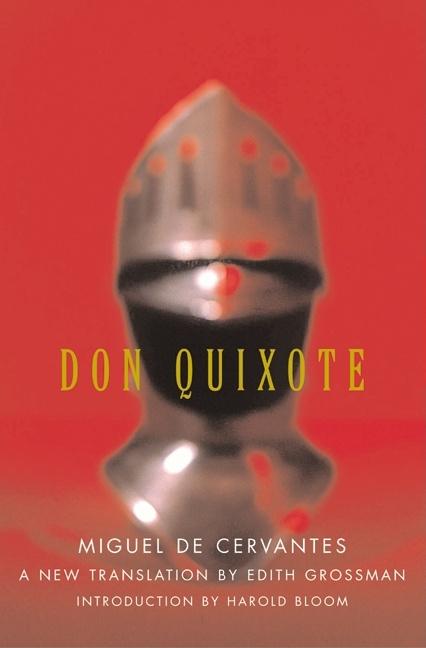
. Translated into English some 20 times since the novel appeared in two parts in 1605 and 1615, and at least five times in the last half-century, it is currently available in multiple editions (the most recent is the 1999 Norton Critical Edition translated by Burton Raffel). Yet Grossman bravely attempts a fresh rendition of the adventures of the intrepid knight Don Quixote and his humble squire Sancho Panza. As the respected translator of many of Latin America's finest writers (among them Gabriel García Márquez, Carlos Fuentes and Mario Vargas Llosa), she is well suited to the task, and her translation is admirably readable and consistent while managing to retain the vigor, sly humor and colloquial playfulness of the Spanish. Erring on the side of the literal, she isn't afraid to turn out clunky sentences; what she loses in smoothness and elegance she gains in vitality. The text is free of archaisms—the contemporary reader will rarely stumble over a word—and the footnotes (though rather erratically supplied) are generally helpful. Her version easily bests Raffel's ambitious but eccentric and uneven effort, and though it may not immediately supplant standard translations by J.M. Cohen, Samuel Putnam and Walter Starkie, it should give them a run for their money. Against the odds, Grossman has given us an honest, robust and freshly revelatory Quixote
for our times. (Nov.)
Forecast:
A somber, graceless jacket won't do this edition any favors, but the packaging of the paperback will be most important in determining future sales. In any case, this will be an essential backlist title.
From Publisher's Weekly
March 1, 1993
As in Williams's Greek Myths for Young Children and Joseph and His Magnificent Coat of Many Colors , engagingly busy, ornately bordered, comic strip-style artwork gives new and buoyant life to a familiar story. The characteristic understatement of her text, juxtaposed with the humorous mutterings of a quirky cast (delivered in cartoon balloons), breezily chronicles Quixote's hapless quest to ``right all wrongs and protect all damsels.'' (Though Williams's rendition seems appropriate for the intended audience, literary purists may object on principle to the abridgement of such a venerable classic.) Here the would-be knight is rendered as quite the buffoon, as he prepares to tilt at windmills he mistakes for ``giants'' and battle two ``armies'' that are actually flocks of sheep. Time after time, Quixote and sidekick Sancho Panza are badly battered (the former is shown losing his ear and some teeth), but always brush themselves off and continue ``on their way in search of new adventure worthy of so famous a knight and his faithful squire.'' A fun way to become acquainted with this masterpiece. Ages 7-up.
From Kirkus
Christopher Casenove employs an impressive range of British accents in his Performance--and presents everyone from earl to washerwoman. Such voices may not be what listeners expect from DON QUIXOTE, but they make it easy to tell who's speaking, even when a scene contains more than one character of a certain "type." Together, the excerpts which comprise this abridgeent convey the tone and spirit of the source without awkward breaks or transitions. The music that begins and ends each tape--solo classical guitar--summons images of the Spanish countryside, and might have done so more effectively had it been integrated into the reading. T.J.W. (c) AudioFile 2002, Portland, Maine
1 Selection for State & Provincial Recommended Reading Lists
Don Quixote was selected by educational and library professionals to be included on the following state/provincial reading lists.
United States Lists (1)
Preview Digital Book
Explore Don Quixote on Marketplace. Access requires OverDrive Marketplace login.
This Book Resume for Don Quixote is compiled from TeachingBooks, a library of professional resources about children's and young adult books. This page may be shared for educational purposes and must include copyright information. Reviews are made available under license from their respective rights holders and publishers.
*Grade levels are determined by certified librarians utilizing editorial reviews and additional materials. Relevant age ranges vary depending on the learner, the setting, and the intended purpose of a book.
Retrieved from TeachingBooks on April 02, 2026. © 2001-2026 TeachingBooks.net, LLC. All rights reserved by rights holders.
